Kenya: Court Ruling on Generic Drugs Sets Precedent for the Region

BY HENRY ZAKUMUMPA, 4 MAY 2012
GUEST COLUMN

Thousands of people living with HIV and Aids in East Africa were given new hope on 25 April 2012, when a high court judge in Nairobi ruled that Kenya’s anti-counterfeit law was unconstitutional in its interpretation of generic HIV drugs as illegal counterfeits.

A generic drug is an identical copy of a branded or listed medicine – one that is usually developed and manufactured by private pharmaceutical companies. Branded drugs, such as those manufactured by Pfizer and Norvatis, are sold at prices tailored to Western markets and thus, generally, are unaffordable for the majority of patients in sub-Saharan Africa.India has developed a thriving generics industry, leading to it being dubbed “the pharmacy of the developed world” for the low cost of its generic drugs, especially antiretrovirals, some of which cost as little as a tenth of the brand price.

Indian generic drug manufacturers such as CIPLA, imitate the exact formulas used in branded antiretroviral (ARV) medicines through a process called ‘reverse engineering. The drugs are the equivalent of the branded products and as effective.

Justice Mumbi Ngugi ruled that intellectual property rights do not override the right to life and health. She found the definition of a β€˜counterfeit’ in the Kenya Anti-Counterfeit Act of 2008 to be too broad leading to generic HIV drugs being bundled together with other counterfeits. Justice Mumbi said this vagueness is posing a grave threat to the right to life and health for thousands of Kenyans who depend on life-saving generic ARVs.

The high court judge has now instructed the Kenyan parliament to review the Anti-Counterfeit Act of 2008 and to amend the offending articles. Until this point, generic HIV drugs could be subject to arbitrary seizure on the assumption that they are β€˜counterfeits’, as happened at a Dutch port last year.

Under common law, a high court ruling in Kenya sets a precedent for countries such as Uganda and Tanzania, and it is now thought that human rights activists in Uganda and the rest of East Africa will invoke the ruling in any potential suits that seek to outlaw generic medicines.

The news also comes as a welcome development for Ugandan pharmaceutical companies such as the Quality Chemicals Plant in Luzira, most of whose products are generic drugs.

While testifying before a Ugandan parliamentary committee last month, Moses Mulumba, a human rights lawyer and intellectual property rights expert, revealed that the Uganda Counterfeit Bill 2010 regards generic Aids drugs as β€˜counterfeits’ and would render 90 percent of HIV drugs in Uganda illegal should the bill be passed by parliament and approved by President Yoweri Museveni.

With efforts to deepen East African regional integration taking centre stage, the Kenya High Court ruling becomes even more instructive for Uganda and the rest of the members of the East African community.β€œ

A vast majority of people in Kenya rely on quality generic drugs for their daily survival. Through this important ruling, the High Court of Kenya has upheld a fundamental element of the right to health,” said UNAIDS Executive Director Michel SidibΓ©. β€œThis decision will set an important precedent for ensuring access to life-saving drugs around the world.”

β€œThe court has correctly interpreted the Constitution and guaranteed the right to health. This ruling speaks against any ambiguity that serves to undermine access to generic medicines and puts the lives of people before profit,” Patricia Asero, one of the three petitioners, was quoted as saying.

The last week of April also marked the successful passage of the East Africa HIV/Aids Prevention and Management Bill 2012 by the East African Legislative Assembly, a timely milestone as the assembly’s term of office expires this June.

Henry Zakumumpa is a Ugandan journalist and a member of the Key Correspondents Team – a network of citizen journalists reporting from some 50 countries who focus on a range of topics including health and community development.

Source:http://allafrica.com/stories/201205050203.html

Kiyunga: A sick health centre

Luuka

Kiyunga Health Centre IV in Luuka District is facing a host of problems impeding service delivery at the facility. People with premature babies at the health facility are forced to light charcoal stoves and lamps to give the babies warmth since there is no electricity at the hospital.

There is congestion at the facility which has only two wards, the maternity and a general ward, the latter is shared by both male and female patients, children and adults.

The facility also lacks a mortuary, a situation which has forced patients on several occasions to share their ward with dead bodies overnight. According to Luuka officials and residents the lack of a mortuary has lead to a miscarriage of justice.

β€œWe find it very hard in cases of death. The hospital where we would take bodies for postmortem has no mortuary and sometimes we fail to access medical (postmortem) reports on such deaths because relatives are left to take their bodies because there is no mortuary,” the acting District Police Commander, Mr Charles Nyongesa, said, citing cases of suspected murder and accidents.

The former mortuary at the hospital is dilapidated and unusable. It is roofless and has no windows.

Mr Wilber Meregulwa, a resident of Kasozi Mawembe in Bulongo Sub-county, says he had to keep the body of his one-and-a-half-year-old boy who died at around 8pm in the ward until the following day.

β€œWe were stranded and some nurses advised me to cover the body within the bed until the next day because I had no ready means of transporting the body to my village and the health centre ambulance lacked fuel,” Mr Meregulwa said.

Dr Matthias Wabwire Panyako, the officer in-charge of the facility, says they are always stranded with bodies after patients die. He says: β€œImmediately one dies, we assist the bereaved relatives to arrange for transporting the body to their respective village. We have an ambulance that was donated by the area MP Johnson Bagoole, readily available for fuelling to remove bodies out of the health facility.”

Dr Panyako says the health facility, which is due for elevation to a district hospital status after rehabilitation by the Ministry of Health expected to start this month, serves more than 150 patients daily and registers at least one death every day.

The District Health Officer, Dr Enock Kwikiriza, says: β€œWe have written to the line ministry to give it (mortuary) a first priority during the redevelopment and maintenance of the centre,” he said.

editorial@ug.nationmedia.com

Source:Β http://www.monitor.co.ug/News/National/-/688334/1398438/-/view/printVersion/-/2g01uhz/-/index.html

Apart from the toilets, what really is free at Mulago hospital?

I have heard a lot about the suffering people go through at the National Referral Hospital, Mulago: congestion, paid parking slots, rude workers, corruption, the filth, etc.

Recently, I experienced this first hand. My mother who is in her 60s was admitted to Mulago and I went to attend to her. We were ushered into a room which only hard old boxes, and the nurse assured me how lucky I was to get a β€˜bed’.

Days rolled; the doctor kept on requesting for a number of tests to be done- all at a fee. The final verdict finally came and the doctor told me my mum was due for operation, that she had goitre. He referred us to another doctor for the operation. I called the doctor and she said Mulago did not have the facilities needed for the operation.

This same doctor told me to raise a minimum of Shs3 million to book a theatre in another hospital where she will perform the operation from. To date, I am speechless how the national referral hospital cannot do an operation other small hospitals around town can handle. As I work round the clock to raise the money for this operation, I keep wondering and asking myself what is really free at Mulago apart from the toilets.

Kiyingi Bbosa,
Student Makerere University

Source:Β http://www.monitor.co.ug/OpEd/Letters/-/806314/1396996/-/view/printVersion/-/oxj10ez/-/index.html

Kenya generic HIV drugs court ruling sets precedent for Uganda

Henry Zakumumpa

Thousands of people living with HIV and AIDS in East Africa were given new hope last week (25 April 2012), when a High Court judge in Nairobi ruled that Kenya’s anti counterfeit law is unconstitutional in its interpretation of generic HIV drugs as illegal counterfeits.

A generic drug is an identical copy of a brand name, the latter of which are usually manufactured by pharmaceutical giants. Brand drugs such as those manufactured by Pfizer and Norvatis go for prices tailored to Western markets and thus are unaffordable for the majority of patients in sub Saharan Africa. However, many can afford Indian generics, which cost as little as a tenth of the brand price.

Generic drug manufacturers such as CIPLA of India imitate the exact formulas used in brand antiretrovirals (ARVs) drugs through a process called β€˜reverse engineering’. The drugs are understood to be as effective as the brand names.

Justice Mumbi Ngugi ruled that intellectual property rights do not override the right to life and health. She found the definition of a β€˜counterfeit’ in the Kenya Anti-Counterfeit Act of 2008 to be too broad leading to generic HIV drugs being bundled together with other counterfeits. Justice Mumbi said this vagueness is posing a grave threat to the right to life and health for thousands of Kenyans who depend on life-saving generic ARVs.

The High Court judge has now instructed the Kenyan parliament to review the Anti Counterfeit Act of 2008 and amend the offending articles, which can lead to arbitrary seizures of generic HIV drugs under the pretext that they are β€˜counterfeits’, as happened at a Dutch port last year.

Under common law, a high court ruling in Kenya sets a precedent for countries such as Uganda and it is now thought that human rights activists in Uganda and the rest of East Africa will invoke the ruling in any potential suits.

The news will also comes as a welcome development for Ugandan pharmaceutical companies such as the Quality Chemicals Plant in Luzira, most of whose products are generic drugs

While testifying before a Ugandan parliamentary committee last month, Moses Mulumba, a human rights lawyer and intellectual property rights expert, revealed that the Uganda Counterfeit Bill 2010 regards generic AIDS drugs as β€˜counterfeits’ and would render 90 % of HIV drugs in Uganda illegal should the bill be passed by parliament and assented to by President Museveni.

With efforts to deepen East African regional integration taking centre stage, the Kenya High Court ruling becomes even more instructive for Uganda and the rest of members of the East African community (EAC).

β€œA vast majority of people in Kenya rely on quality generic drugs for their daily survival. Through this important ruling, the High Court of Kenya has upheld a fundamental element of the right to health,” said UNAIDS Executive Director Michel SidibΓ©.

β€œThis decision will set an important precedent for ensuring access to life-saving drugs around the world.”

β€œThe court has correctly interpreted the Constitution and guaranteed the right to health. This ruling speaks against any ambiguity that serves to undermine access to generic medicines and puts the lives of people before profit”, Patricia Asero, one of the three petitioners, was quoted as saying.

Last week also marked the successful passage of the East Africa HIV/AIDS Prevention and Management Bill 2012 by the East African Legislative Assembly (EALA), a timely milestone as the assembly’s term of office expires in June this year.

Feature: Maternal health case puts govt on the spot

As Sylvia Nalubowa cried out in agony and begged the nurses to help her, she pledged to give them part of her kibanja (plot of land), hens and pigs if they could save her life.

Only 38, Nalubowa had developed complications after she managed to give birth to one of her twins normally. With the second baby twin still posited in her uterus, Nalubowa’s mother-in-law, Rhoda Kukkirizza, moved her from the government health centre III in Mityana to Mityana district hospital, hoping Nalubowa would get better services there. She did not. An affidavit to a Constitutional Court petition, challenging government to provide better maternal health services, states that Nalubowa died at the hands of negligent and corrupt medical workers.

She became part of the statistics that are Uganda’s maternal mortality rate or MMR (the number of women that die whilst giving birth). Standing at 435 of 100,000 live births, there is general consensus that Uganda’s MMR remains unacceptably high. In 2009, Nalubowa’s tragic tale put a face to the country’s MMR. Her death shook the administration of Mityana district hospital and the ripples spread throughout the nation. It did not take the civil society long to voice its disgust.

The Centre for Health, Human Rights and Development (CEHURD) did more than voice its disgust. It lodged a constitutional petition, seeking a declaration that government’s failure to provide proper maternal health services to women be deemed a violation of their rights.
Nalubowa’s family, together with that of Jennifer Anguko, another woman who died due to negligence during childbirth in 2010, are among the petitioners seeking justice, not just for their departed relatives, but also for other women who have lost their lives while giving life, as well as others likely to become statistics in Uganda’s grim MMR.

Filed on March 3, 2011, the case kicked off with a very high momentum and attracted ample interest from the media and Ugandans at large. It was supported by affidavits from the families of Nalubowa and Anguko, and from human rights experts like Professor Ben Twinomugisha (Dean, faculty of Law at Makerere University). In their submissions to court, the petitioners argued that the right to health was a human right the government had failed to respect and protect.

The state, however, denied violating women’s right to health, contending that the petition was speculative and without merit. But the petitioners insisted that the maternal deaths were due to government failure to provide basics like razor blades, plastic sheets and other consumables, let alone medicines and medical personnel to attend to pregnant women.

In response, the state reasoned that the government’s meagre resources have to cater for various competing interests that also affect other human rights. And, health aside, the state said the petition raised political rather than legal questions, and objected to court hearing it. The petitioners now await the court’s decision on whether or not it will hear the case.

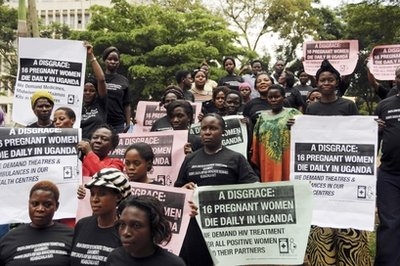
β€œWe just want court to tell us whether the death of over 16 women due to child birth-related complications is not a violation of human rights. Why is the judiciary dragging its feet?” says David Kabanda, a lawyer for the petitioners.

A letter signed by Deputy Chief Justice Mpagi Bahigeine not only expresses regret at the delay in delivering the ruling, but also promises that everything possible is being done to ensure disposal of the case.

But the petitioners are not convinced. β€œWe do not want regrets,” Kabanda says. β€œWe want a ruling. The judiciary should tell us if they do not have the mandate to decide the case so that we seek other avenues.”

He adds that if the Constitutional Court has expediently disposed of other cases β€” like the one that challenged the Inspector General of Government’s mandate to prosecute cases of corruption, a case also filed in 2011 β€” it should be in position to quickly decide on the pertinent issue of women’s lives.

β€œWe understand that there is backlog and the judiciary is understaffed, but priority should go to the rights of pregnant women. Pregnancy will not wait. Every day, 16 women die due to pregnancy-related complications,” Kabanda says.

Judiciary only hope
Uganda’s Constitution has a comprehensive bill of rights, but its rich provisions on human rights have not necessarily translated into respect for human rights in the country. In addition, Uganda is signatory to international human rights instruments such as the Convention on the Elimination of all forms of Discrimination against Women, the International Covenant on Economic, Social and Cultural Rights, the Convention on the Rights of a Child, and the regional African Charter on Human and People’s rights.

All these protect the rights of women and children, and the right to health. On December 15, 2011, Parliament passed a resolution, which, if executed, would come in handy in addressing the issue of maternal mortality. The resolution urges government to expedite the reformation of the midwives’ training curriculum and to recruit a minimum of 2,000 well-trained and well-motivated midwives and other medical personnel.

It further says government should report periodically to Parliament on progress on maternal health. Uganda, as a member of the World Health Organisation’s Safe Motherhood programme, is expected to spend $1.40 per capita on maternal health. It, however, currently spends only $0.50, a mere 36 percent of the required minimum per capita.

The reality is that at the entrance of any government hospital in Uganda, a woman going to give birth is required to present a plastic sheet, razorblade, cotton wool, gauze and other consumables before she can receive any medical attention. Bribes to medical personnel are the norm, and experiences like Nalubowa’s read like a familiar folktale told over and over again. But can a court ruling turn around the tragic scenario where 5,840 women die in child birth each year? Time will tell.

pakumu@observer.ug

Source:Β http://www.observer.ug/index.php?option=com_content&view=article&id=18444:feature-maternal-health-case-puts-govt-on-the-spot&catid=34:news&Itemid=114